
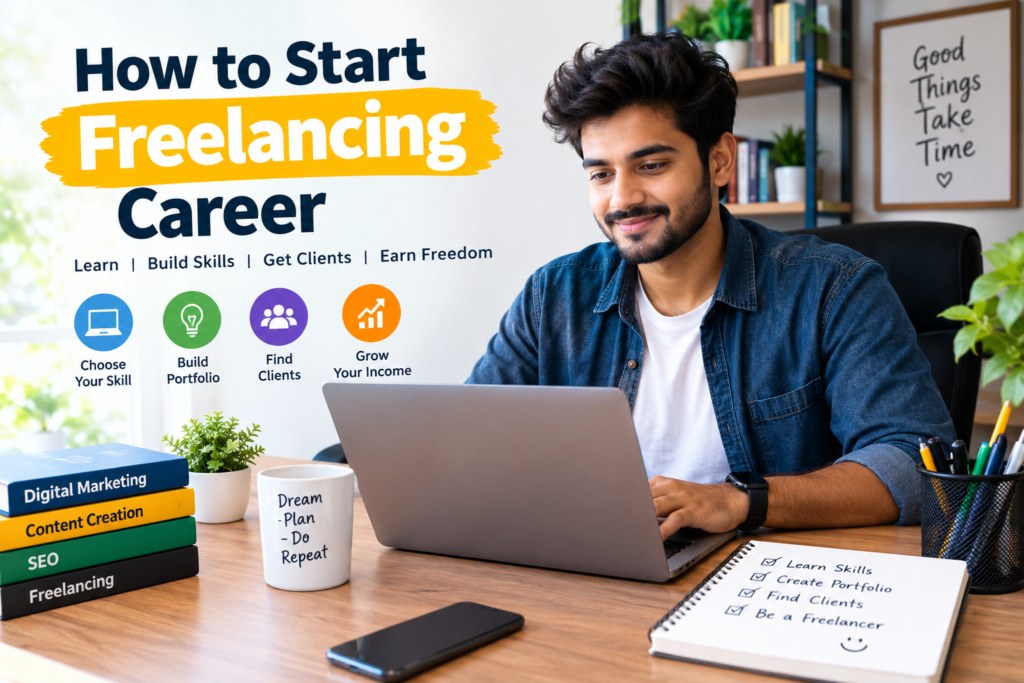
Freelancing has become one of the most popular ways to earn money online. Unlike a traditional job, freelancing allows you to work independently, choose your projects, work with different clients, and often work from home. If you have been wondering how to start freelancing career, the good news is that you do not necessarily need years of experience or a large investment to get started.
Table of Contents
Many beginners believe that freelancing is only for experienced professionals. However, students, graduates, freshers, and people changing careers can also build a successful freelancing career by learning a useful skill and consistently finding clients.
In this guide, you will learn how to start freelancing, which skills you should learn, how to create a portfolio, where to find clients, and how to get your first freelance project.
What Is Freelancing?
Freelancing is a type of independent work where a person provides services to clients without becoming a permanent employee of the company. A freelancer may work with one or several clients at the same time.
For example, a freelancer can provide services such as:
- Digital marketing
- Content writing
- Graphic designing
- Web development
- SEO
- Social media management
- Video editing
- Virtual assistance
- Copywriting
- Email marketing
The freelancer generally charges clients according to the project, hourly work, or monthly service package.
If you want to know how to start freelancing career, the first thing you need to understand is that freelancing is not simply about creating an account on a freelancing website. It is about developing a marketable skill and learning how to sell that skill to clients.
Why Should You Start a Freelancing Career?
There are several reasons why people choose freelancing instead of depending completely on traditional employment.
1. Work From Anywhere
One of the biggest advantages of freelancing is flexibility. Depending on your type of work and client requirements, you can work from home or almost anywhere with a reliable internet connection.
2. Flexible Working Hours
Freelancers generally have more control over their working schedule. You can organize your working hours according to your availability, although client deadlines must still be respected.
3. Multiple Income Opportunities
A freelancer can work with multiple clients instead of depending on one employer. As your experience and client base increase, your earning opportunities can also increase.
4. Low-Cost Career Option
Starting freelancing does not usually require a physical office. A computer, internet connection, suitable software, and a useful skill can be enough to begin.
5. Opportunity to Build Your Own Brand
Freelancing can eventually become more than individual project work. You can create a personal brand, build a website, develop long-term client relationships, and eventually start an agency.
How to Start Freelancing Career Step by Step
If you are completely new to freelancing, follow these steps.
Step 1: Choose a Freelancing Skill
The first step in learning how to start freelancing career is choosing one skill that businesses are willing to pay for.
Some popular skills for beginners include:
- SEO
- Content writing
- Social media marketing
- Graphic design
- WordPress website development
- Video editing
- Email marketing
- Data entry
- Virtual assistance
Do not try to learn ten different skills at the same time. Choose one primary skill and become good at it first.
How to Choose the Right Skill?
Consider three things:
- What do you enjoy learning?
- What skills are in demand?
- Can businesses benefit from your service?
For example, if you are interested in marketing, digital marketing freelancing can be a good option. You can specialize in SEO, social media marketing, paid advertising, content marketing, or email marketing.
Step 2: Learn the Skill
After choosing your skill, spend time learning it properly.
You can learn through:
- Online courses
- YouTube tutorials
- Blogs
- Practical projects
- Free learning resources
- Books
- Practice websites
Learning theory alone is not enough. You need practical experience.
For example, if you want to become an SEO freelancer, learn keyword research, on-page SEO, technical SEO, off-page SEO, content optimization, and basic analytics.
Practice Before Finding Clients
Before approaching clients, create sample projects.
If you want to become a content writer, write sample blog posts.
If you want to become a graphic designer, create sample social media posts.
If you want to become an SEO freelancer, create a sample SEO audit.
These projects can become the foundation of your portfolio.
Step 3: Select a Freelancing Niche
A niche is a specific area in which you offer your service.
For example, instead of saying:
“I provide digital marketing services.”
You could specialize in:
“I help small businesses improve their online visibility through SEO and content marketing.”
A niche makes it easier for potential clients to understand what you do.
Some examples of freelancing niches are:
- SEO for local businesses
- Social media marketing for restaurants
- Content writing for technology companies
- Graphic design for startups
- WordPress websites for small businesses
As a beginner, choosing a niche can help you build expertise and create more relevant portfolio samples.
Step 4: Create a Strong Portfolio
A portfolio shows potential clients what you can actually do.
You do not need previous clients to create your first portfolio. You can create sample projects yourself.
For example, a beginner digital marketer can create:
- SEO audit samples
- Keyword research reports
- Social media calendars
- Sample advertisements
- Blog articles
- Competitor analysis
- Website SEO recommendations
Your portfolio should focus on quality rather than quantity.
What Should Your Portfolio Include?
A basic portfolio can include:
- Your introduction
- Your services
- Your skills
- Sample projects
- Results or project objectives
- Client testimonials, when you have them
- Contact information
Having a personal website can also make your freelancing profile look more professional.
Step 5: Create Freelancing Profiles
Once you have a skill and portfolio, create profiles on suitable freelancing platforms.
Popular platforms include:
- Upwork
- Fiverr
- Freelancer
- PeoplePerHour
- Contra
Do not create a profile and simply wait for clients. Your profile should clearly communicate what problem you solve and what service you provide.
Write a Professional Profile
Your profile should explain:
- Who you help
- What service you provide
- What skills you have
- What makes your service useful
- What type of projects you accept
Avoid writing a generic description such as “I am hardworking and passionate.” Instead, focus on the value you can provide to the client.
Step 6: Learn How to Find Freelance Clients
Knowing how to get freelance clients is just as important as learning the skill itself.
There are several ways to find clients.
Freelancing Platforms
You can search for relevant projects and submit proposals. Make each proposal specific to the client’s requirements.
LinkedIn can be useful for connecting with business owners, marketers, founders, and recruiters. Share useful content and demonstrate your expertise.
Social Media
You can use platforms such as Instagram, Facebook, and X to showcase your work and connect with potential clients.
Direct Outreach
You can identify businesses that may need your service and contact them professionally.
For example, if you offer SEO services, you could identify a local business with a poorly optimized website and explain a few opportunities for improvement.
Step 7: Learn How to Write a Freelance Proposal
A good proposal should not look like a copy-pasted message.
Start by understanding the client’s requirement. Then explain briefly how you can help.
A basic proposal structure is:
- Mention the client’s requirement.
- Explain your relevant skill.
- Mention how you would approach the project.
- Share relevant portfolio samples.
- Ask an appropriate question or suggest the next step.
Keep your proposal short, professional, and focused on the client.
Step 8: Set Your Freelance Pricing
Pricing is one of the most confusing parts of freelancing for beginners.
You can charge clients in different ways:
- Hourly rate
- Fixed project price
- Monthly retainer
- Service package
When starting out, your prices should be competitive but should not be unrealistically low.
Do not compete only on price. Focus on improving your skills and showing clients the value of your work.
As your experience, portfolio, testimonials, and results improve, you can gradually increase your rates.
Step 9: Deliver Quality Work
Getting your first client is important, but delivering excellent work is even more important.
Always:
- Understand the requirements
- Confirm deadlines
- Communicate professionally
- Provide regular updates
- Check your work before delivery
- Make reasonable revisions
- Maintain professionalism
A satisfied client can provide a testimonial, repeat work, or refer you to another business.
Step 10: Build Long-Term Client Relationships
A successful freelancing career is not only about finding new clients every week.
Try to convert one-time clients into long-term clients by consistently delivering quality work.
For example, an SEO freelancer could offer monthly SEO management after completing an initial SEO audit.
A social media freelancer could offer monthly content creation and account management.
Long-term clients can provide more predictable income and reduce the pressure of constantly searching for new projects.
Contact us for info
How to Start Freelancing With No Experience
One of the most common questions beginners ask is how to start freelancing with no experience.
The answer is to create experience through practice projects.
You can:
- Learn one marketable skill.
- Create three to five sample projects.
- Build a portfolio.
- Create professional profiles.
- Start applying for beginner-friendly projects.
- Offer a small initial project.
- Collect genuine testimonials after completing work.
- Improve your portfolio continuously.
Remember that everyone starts somewhere. Your first project may be small, but it can become the starting point for your freelancing career.
Common Mistakes Freelancing Beginners Should Avoid
Trying to Learn Everything
Do not try to become a designer, developer, SEO expert, writer, and video editor simultaneously. Start with one core skill.
Copying Other Freelancers
Study successful profiles for inspiration, but create your own profile, portfolio, and communication style.
Charging Extremely Low Prices
Very low pricing can attract difficult clients and make it harder to build a sustainable career.
Ignoring Communication
Even excellent technical skills cannot compensate for poor communication.
Expecting Instant Success
Freelancing usually requires patience. Your first client may take time. Keep improving your skills, portfolio, and outreach strategy.
Best Freelancing Skills for Beginners
If you are still deciding what to learn, consider skills such as:
| Skill | Beginner Friendly | Potential Services |
|---|---|---|
| Content Writing | Yes | Blog posts, website content |
| SEO | Yes | Keyword research, SEO audits |
| Social Media Marketing | Yes | Content planning, management |
| Graphic Design | Yes | Social media posts, banners |
| WordPress | Yes | Website creation |
| Video Editing | Yes | Reels, YouTube videos |
| Virtual Assistance | Yes | Administrative support |
Choose a skill based on your interest, learning ability, and market demand.
How Long Does It Take to Start Freelancing?
There is no fixed timeline for becoming a freelancer. Some people may get their first project within weeks, while others may need several months.
Your timeline depends on:
- Your skill level
- Portfolio quality
- Communication skills
- Number of proposals
- Networking
- Type of service
- Client demand
Instead of focusing only on how quickly you can earn money, focus on becoming good enough to solve real problems for clients.
FAQs About How to Start Freelancing Career
Can I start freelancing without experience?
Yes. You can start freelancing without professional experience by learning a skill, creating sample projects, building a portfolio, and applying for suitable beginner-level projects.
How much money can a beginner freelancer earn?
There is no fixed income for freelancers. Earnings depend on the skill, project type, pricing, experience, number of clients, and working hours.
What is the best freelancing skill for beginners?
There is no single best skill for everyone. SEO, content writing, social media marketing, graphic design, WordPress, video editing, and virtual assistance can all be potential starting points.
How can I get my first freelance client?
Build a strong portfolio, create professional freelancing profiles, submit personalized proposals, network on LinkedIn and social media, and contact potential clients directly.
Can I freelance while doing a job?
Yes. If your employment contract and local rules allow it, you can freelance as a side activity. Make sure your freelance work does not conflict with your employer’s policies.
Do I need a degree to become a freelancer?
Usually, clients care more about your skills, portfolio, communication, reliability, and results than a specific degree. However, requirements can vary depending on the service.
Is freelancing a good career for beginners?
Yes, freelancing can be a good career option for beginners who are willing to learn a marketable skill, build a portfolio, find clients, and consistently improve.
Conclusion
Learning how to start freelancing career is easier when you break the process into small steps. You do not need to wait until you become an expert. Start by choosing one useful skill, learn it properly, practice through real projects, and build a strong portfolio.
After that, create professional freelancing profiles, learn how to write proposals, find potential clients, and deliver high-quality work. Your first project may be small, but every completed project can help you build experience, confidence, testimonials, and a stronger portfolio.
The most important thing is consistency. A successful freelancing career is built over time through skills, relationships, quality work, and continuous learning. If you are serious about freelancing, start with one skill today and take your first practical step toward becoming a freelancer.
Contact Us For More Info.https://manishmedia.com/contact-us/